Psychedelic-Assisted Therapy
Opening the mind.
Listening to the body.
Creating space for transformation.


“Psychedelics are to the study
of the mind what the microscope is to biology
and the telescope is to astronomy.”
— Dr. Stanislav Grof
“We can actually get at the underlying causes of mental illness rather than just treating the symptoms.”
— Dr. Robin Carhart-Harris
“Psychedelics help you to dissolve
your ego and experience an
expanded sense of self,
which can be profoundly healing.”
— Michael Pollan
“In controlled settings, psychedelics have the potential to cure, not just treat, mental illness.”
— Dr. Rick Doblin
“The potential of psychedelic therapy
is to provide a profoundly meaningful experience that helps people change their lives.”
— Dr. Roland Griffiths
"Psychedelics are the door. Meditation is the key. Integration is the map"
— Paul Austin
"Psychedlics are windex to the heart, the medicine."
— Dr. Kristen Beau
Opening the mind. Listening to the body. Creating space for transformation.
Healing is more than understanding our experiences. It is also about how we feel, how we relate, and how we carry our stories within our bodies.
At AlpenMind, psychedelic-assisted therapy is approached with curiosity, compassion, and deep respect for the complexity of the human experience. Rooted in contemporary psychology, contemplative wisdom, and somatic awareness, this work offers an opportunity to explore our inner landscapes and cultivate a more meaningful relationship with ourselves, others, and the living world.
I believe meaningful healing involves more than changing how we think. It asks us to listen to the body, honor our emotions, and reconnect with the parts of ourselves that may have become disconnected through stress, trauma, grief, or the demands of everyday life.
Shift in Perspective on Healing
Sometimes, a shift in perspective opens the possibility for change.
Psychedelic-assisted approaches are gaining renewed attention in mental health care as researchers explore their potential to support emotional well-being, psychological flexibility, and new ways of understanding difficult experiences.
For some individuals, these approaches may offer an opportunity to step outside familiar patterns of thinking and relating, creating space for fresh perspectives, emotional exploration, and greater self-awareness.
What makes this work particularly meaningful to me is its potential to bring together insight and embodied experience.
We can intellectually understand our patterns, recognize where they began, and even know what needs to change, yet still feel those patterns deeply within our bodies and nervous systems.
Therapeutic experiences that engage both mind and body may offer another way to explore these patterns, with curiosity rather than judgment.
The intention is not to escape ourselves, but to develop a deeper relationship with who we are.
The Mind–Body Connection
The body holds an essential part of our story.
Our experiences are not stored only as thoughts or memories. They also influence our emotions, physical sensations, patterns of tension, and responses to stress and safety.
The mind and body are in constant conversation.
When we experience prolonged stress, grief, or trauma, our nervous systems may develop protective patterns that continue long after the original circumstances have changed.
I believe healing involves learning to recognize these responses with compassion, rather than viewing them as something that needs to be fought or fixed.
My therapeutic approach integrates somatic awareness, mindfulness, emotional exploration, and relational connection. Within an appropriately supported medicine-assisted experience, these practices can help us notice what arises, remain curious about our inner world, and explore new ways of responding.
Healing is not simply about gaining insight. It is about allowing that understanding to become part of how we live, relate, and experience ourselves.
Set & Setting: Creating the Conditions for Healing
The environment we create within and around ourselves matters.
In psychedelic-assisted therapy, set and setting are foundational considerations.
Set refers to our inner landscape—the intentions, expectations, emotions, beliefs, and experiences we bring into a therapeutic session.
Setting refers to the environment in which the experience unfolds, including the physical space, the therapeutic relationship, and the sense of safety, trust, and support surrounding the experience.
Both can profoundly influence how an experience is perceived and navigated.
At Alpenmind, I believe preparation is an essential part of the therapeutic journey. Before a medicine-assisted experience, we take time to explore your intentions, understand your personal history, establish trust, and cultivate practices that support emotional grounding.
The therapeutic environment is approached with equal care. A calm, comfortable space, thoughtful attention to sensory experiences, and the presence of appropriate professional support can help create conditions in which a person feels more able to explore their inner world.
Set and setting are not about controlling an experience or guaranteeing a particular outcome. They are about approaching the unknown with intention, preparation, and respect.
Healing is not something we can force, but we can thoughtfully cultivate the conditions that support it.
Ketamine-Assisted Psychotherapy
An opportunity for exploration, reflection, and meaningful change.
Ketamine-assisted psychotherapy combines the therapeutic use of ketamine, when medically appropriate, with intentional psychological support.
Ketamine has received growing attention in mental health research, particularly for its potential to produce rapid antidepressant effects in some individuals experiencing difficult-to-treat depression.
During a ketamine experience, some people describe changes in their usual patterns of thought, a different perspective on personal experiences, or a sense of distance from familiar emotional narratives.
These experiences vary considerably from person to person and do not guarantee a particular insight or outcome.
At AlpenMind, the therapeutic relationship remains central. I emphasize careful preparation, a supportive environment, mindful attention to the experience, and thoughtful integration afterward.
Ketamine is not appropriate for everyone. Medical screening, prescribing, and monitoring are essential parts of determining whether this approach may be suitable.
What is Psychedelic-Assisted Therapy?
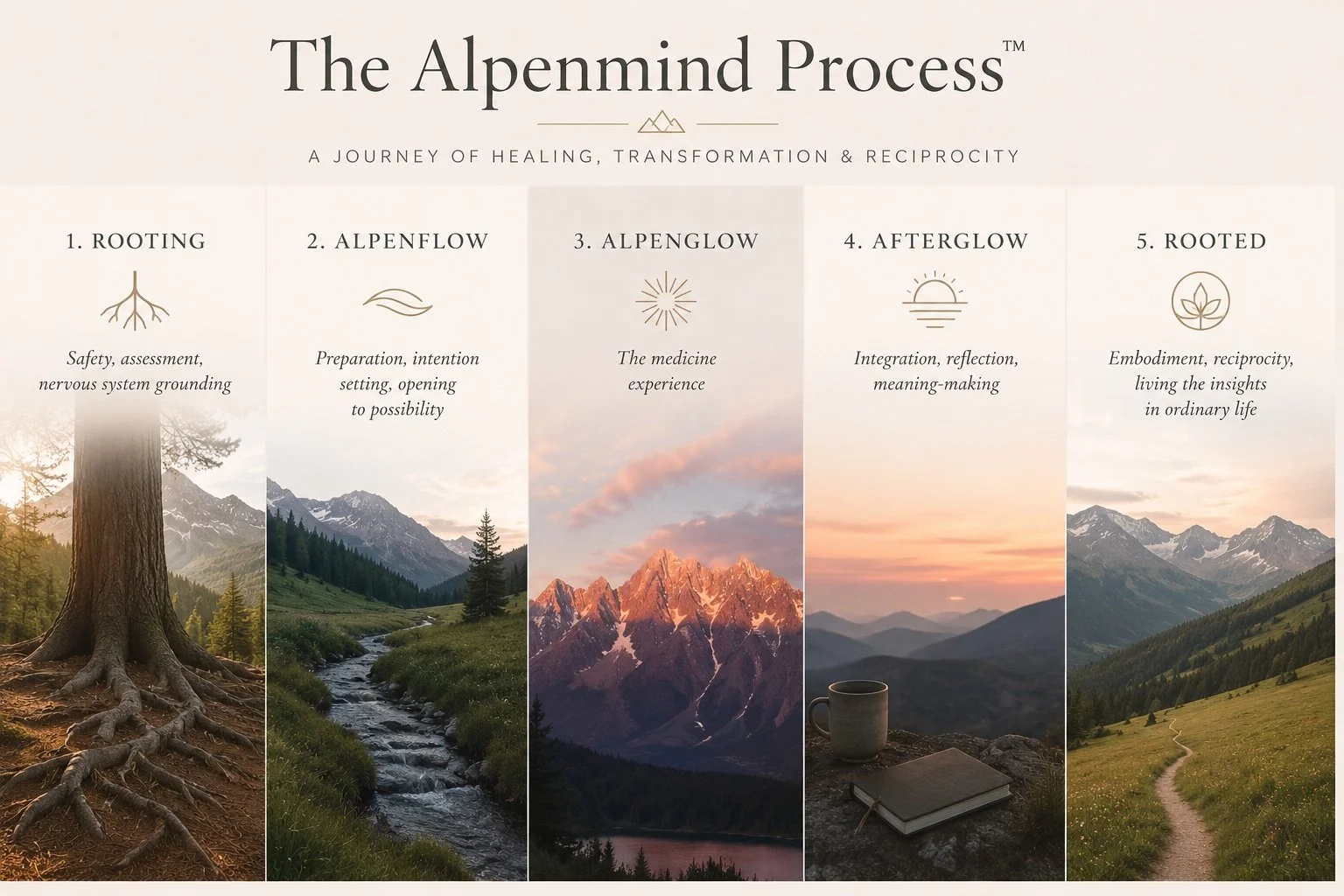
The AlpenMind Process
From preparation to integration, every step matters.
Meaningful therapeutic work begins long before a medicine experience and continues well beyond it.
My approach is informed by the five stages of the AlpenMind Process:
Rooting — Establishing Safety and Grounding
We begin by building trust, exploring your history and intentions, and cultivating the emotional and physical foundations for meaningful therapeutic work.
2. Alpenflow — Preparation and Opening
Through reflection, mindfulness, and intention setting, we create space for curiosity, openness, and the possibilities that may emerge.
3. Alpenglow — The Therapeutic Experience
When clinically appropriate and legally authorized, a supported medicine experience offers an opportunity for exploration within a carefully considered therapeutic setting.
4. Afterglow — Reflection and Integration
We explore the emotions, insights, and questions that emerge, helping you make sense of the experience and its possible significance.
5. Rooted — Embodying Change
The work continues as we explore how new awareness can inform everyday choices, relationships, habits, and ways of being.
Integration: Bringing Insight Into Everyday Life
The experience may open a door. Integration is how we learn to walk through it.
A meaningful experience does not automatically create lasting change.
Integration is the process of reflecting on what has emerged and discovering how those insights might inform our everyday lives.
Through conversation, mindfulness, somatic awareness, and thoughtful reflection, we explore how to translate an experience into meaningful and sustainable growth.
This may involve developing healthier relationships, cultivating self-compassion, understanding emotional patterns, reconnecting with personal values, or making changes that support a more authentic life.
Integration can also be valuable for individuals seeking therapeutic support in understanding past experiences, independent of any medicine administration.
My hope is that this work helps people move beyond the pursuit of extraordinary experiences and toward something more enduring: a grounded, compassionate, and connected relationship with life.
Resources & Further Exploration
Curiosity is an important part of the healing journey.
Understanding the science, history, and therapeutic potential of psychedelic-assisted therapy can help us approach this evolving field with greater awareness, intention, and discernment.
I've gathered a collection of conversations, documentaries, and books that explore neuroscience, trauma, consciousness, the mind–body connection, and the importance of preparation and integration.
Featured Resources
1. The Neuroscience of Psychedelic Therapy
Dr. Robin Carhart-Harris joins Huberman Lab to explore emerging research on consciousness, mental health, and the therapeutic possibilities of altered states.
2. Preparing for a Therapeutic Experience
A conversation exploring the importance of intention, emotional readiness, preparation, and the conditions that support a thoughtful experience.
3. How to Change Your Mind — Michael Pollan
An accessible exploration of the history, science, and evolving understanding of psychedelic research and consciousness.
4. Fantastic Fungi — Documentary
A visually beautiful exploration of the natural world, interconnected ecosystems, and the extraordinary role fungi play in life on Earth.
5. The Importance of Community in Healing
A conversation about connection, belonging, and the role of supportive relationships in therapeutic experiences and integration.
Explore More Resources
For those who wish to continue learning.
Podcasts: Neuroscience & Mental Health
Huberman Lab
Psychedelic Research and Mental Health — Dr. Matthew Johnson
Genes and the Inheritance of Memories Across Generations — Dr. Oded Rechavi
The Science of Medicine-Assisted Therapy: Benefits and Risks
Podcasts: Trauma, Healing & Integration
Healing from Trauma and Rebuilding Relationships — Psychedelic Stories
Where Science and Spirit Meet: Psychedelics and Epigenetics — Dr. David Rabin
Rising from the Ashes: Transcending Trauma — Dr. Melissa Barker
Documentaries & Conversations
Recommended Reading
These resources are shared for education and reflection. They represent a variety of perspectives and do not necessarily reflect established clinical evidence or recommendations for treatment. They are not an endorsement of unsupervised medicine use.
Begin the Process
Every meaningful journey begins with curiosity.
You don't need to know whether psychedelic-assisted therapy is right for you before reaching out.
Whether you're interested in ketamine-assisted psychotherapy, seeking support with preparation and integration, or simply curious about the relationship between mind, body, and healing, I welcome a conversation.
Together, we can explore your intentions, answer questions, and consider whether this pathway aligns with your needs.
Your path toward healing, meaning, and connection can begin here.